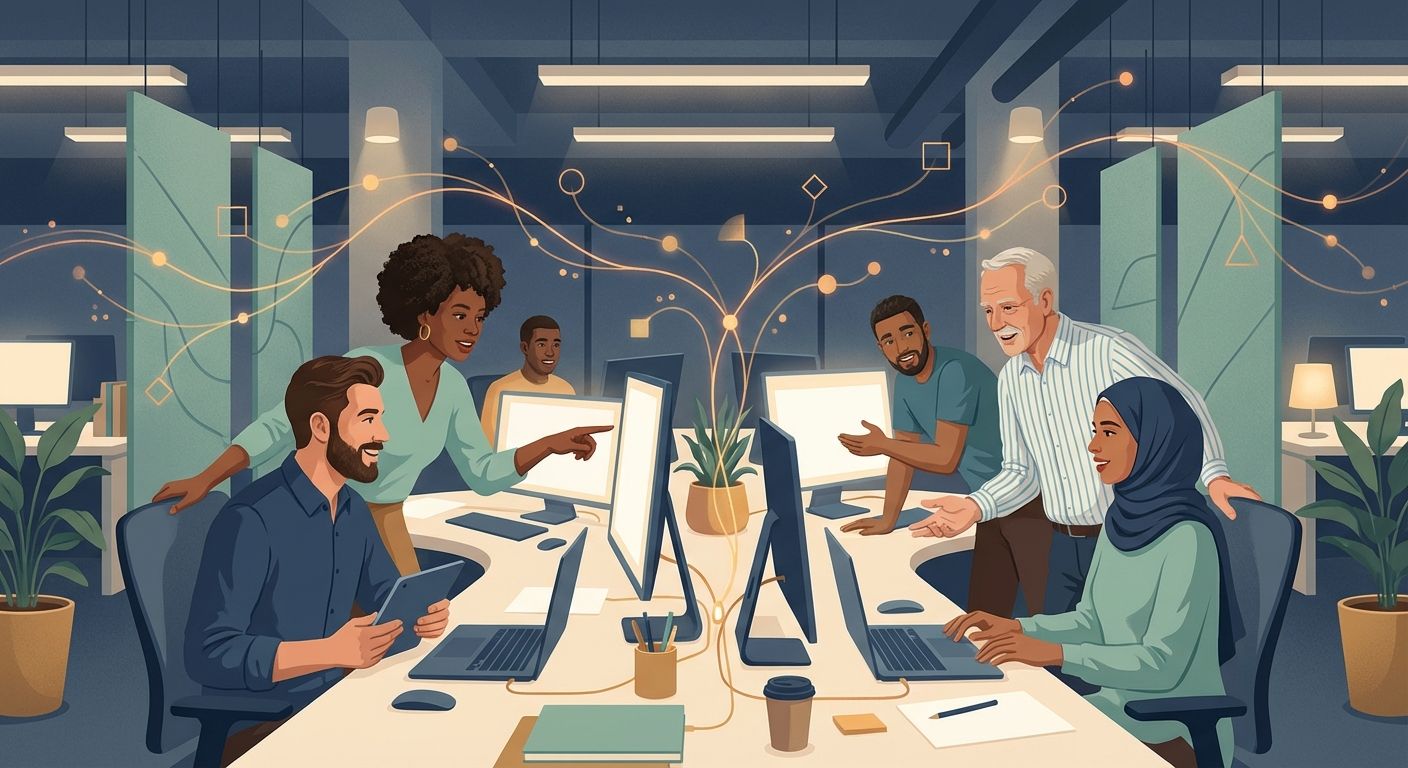
There is a pattern we see in nearly every organisation we work with. The team has talented individuals. Smart people who care about their craft. But somehow, the sum is less than the parts. Decisions get stuck. Knowledge lives in one person's head. When that person goes on leave, everything slows down.
The issue is rarely about individual skill. It is about how the team learns, shares, and grows together.
The Problem with the 10x Developer Myth
The industry loves the idea of the exceptional individual who can turn a project around alone. These people exist—but building around them is fragile.
When one person holds all the knowledge, you haven’t built a team; you’ve built a dependency. And dependencies are risks.
The alternative is deliberate knowledge distribution: designing your ways of working so that no single departure can derail the project. This does not happen by accident.
What a Learning Team Looks Like
Learning teams have clear, observable behaviours:
- They ask questions openly.
There is no social cost to saying “I don’t know” or “can you explain that?” Pretending to understand is treated as more dangerous than admitting confusion.
- They share context, not just code.
Work doesn’t end at “PR merged.” People explain why they chose an approach, what alternatives they considered, and which trade‑offs they accepted.
- They rotate responsibilities.
Nobody is the permanent owner of a domain. People move between areas of the codebase, between frontend and backend, between features and infrastructure. It’s uncomfortable at first and invaluable over time.
- They reflect regularly.
Not just in formal retros that can become performative, but in ongoing, honest conversations about what is and isn’t working—often informally, as part of the daily rhythm.
Pair Programming as Knowledge Transfer
Pair programming is one of the most effective—and most resisted—tools for building a learning culture.
It feels slow. It feels like being watched. That discomfort is the point.
When two people work together:
- They must articulate their thinking.
- They can’t hide behind habit or instinct.
- They expose gaps in their own reasoning.
An hour of pairing can transfer understanding that would take weeks of documentation and months of solo work to develop.
Psychological Safety as a Precondition
None of this works without psychological safety.
If people fear looking foolish, they won’t ask questions. If mistakes are punished, they’ll be hidden. If seniority decides whose ideas matter, junior people will stop contributing.
Psychological safety is not about being nice. It’s about:
- Valuing intellectual honesty over being right.
- Treating changing your mind as a strength.
This starts with leadership. When the most senior people ask questions, admit uncertainty, and visibly change their minds in response to better arguments, everyone else gets permission to do the same.
Practical Steps to Build a Learning Team
This is not a one‑off initiative; it’s a continuous practice. Some concrete moves:
- Start each week with a learning goal.
Not just “what will we ship?” but “what will we understand better by Friday?”
Example: “This week we want to understand how the payment system handles retries.”
- Run internal tech talks.
Short, informal, frequent. Anyone can present. The goal is practice explaining ideas and exposing the team to different perspectives, not polished performance.
- Make code review a conversation.
Whenever possible, review synchronously. Walk through the code together, discuss alternatives, explore edge cases. Treat review as a learning moment, not a gate.
- Celebrate questions, not just answers.
Call out questions that change direction or reveal gaps in understanding. Signal that curiosity is a first‑class contribution.
- Document decisions, not just code.
Use lightweight decision records: what was decided, why, what alternatives were rejected, and links to relevant discussions. This builds institutional memory that survives team changes.
Playing the Long Game
You won’t see a dramatic productivity spike in the first month. But over 6–24 months, the compounding effect is significant:
- Faster onboarding and less knowledge loss when people leave.
- Better, more resilient designs because more minds understand the system.
- Teams that adapt quickly to change instead of freezing when a key person is unavailable.
- A working environment that is simply more enjoyable to be part of.
The strongest engineering teams are not the ones with the most individually talented people. They are the ones that have built the capacity to grow together.
That capacity—shared learning, shared context, shared ownership—is the most valuable asset a technology organisation can build.